
DR Finance India Daily
What Is Net Interest Margin (NIM)?
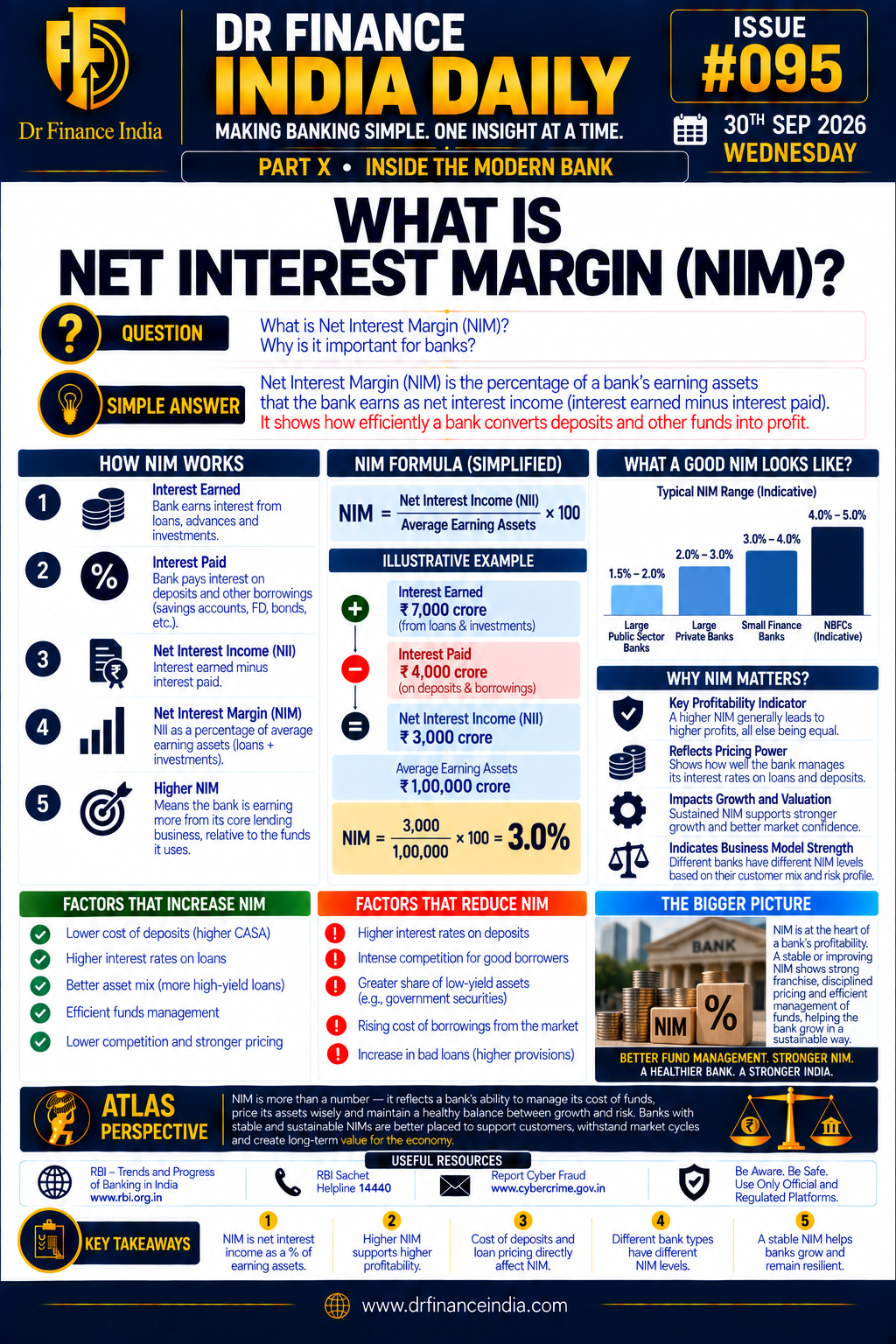
Net Interest Margin relates net interest income to earning assets and is an important indicator of a bank's core lending economics.
Published by Dr Finance India · Educational content — not financial advice
Official Issue Poster
The Question
What is Net Interest Margin (NIM)?
The Simple Answer
Net Interest Margin, or NIM, is a commonly used measure of how effectively a bank earns net interest income from its earning assets — relating interest earned minus interest paid to the bank's average earning assets.
Why It Matters
NIM helps explain the economics of a bank's core intermediation business and is most useful when considered together with asset quality, growth, costs, fee income and risk.
Detailed Explanation
Net Interest Margin, or NIM, is a commonly used measure of how effectively a bank earns net interest income from its earning assets. In simplified terms, it relates interest earned minus interest paid to the bank's average earning assets.
NIM is influenced by loan and investment yields, deposit and borrowing costs, the mix of assets and liabilities, competition, interest-rate conditions and other balance-sheet factors.
A higher NIM can support profitability, but it should not be interpreted in isolation. Different types of banks can operate with different business models, customer segments and risk profiles.
Key Takeaways
- ✓NIM measures how effectively a bank earns net interest income from earning assets.
- ✓It is influenced by loan yields, deposit costs, asset mix and interest-rate conditions.
- ✓A higher NIM can support profitability but should not be read in isolation.
- ✓Different banks operate with different business models and NIM profiles.
- ✓NIM is most useful alongside asset quality, growth, costs and fee income.
Borrower Takeaway
NIM helps explain the economics of a bank's core intermediation business. It is useful when considered together with asset quality, growth, costs, fee income and risk.
Atlas Perspective
NIM helps explain the economics of a bank's core intermediation business. It is useful when considered together with asset quality, growth, costs, fee income and risk.
Share This Insight