
DR Finance India Daily
How Do Banks Actually Make Money?
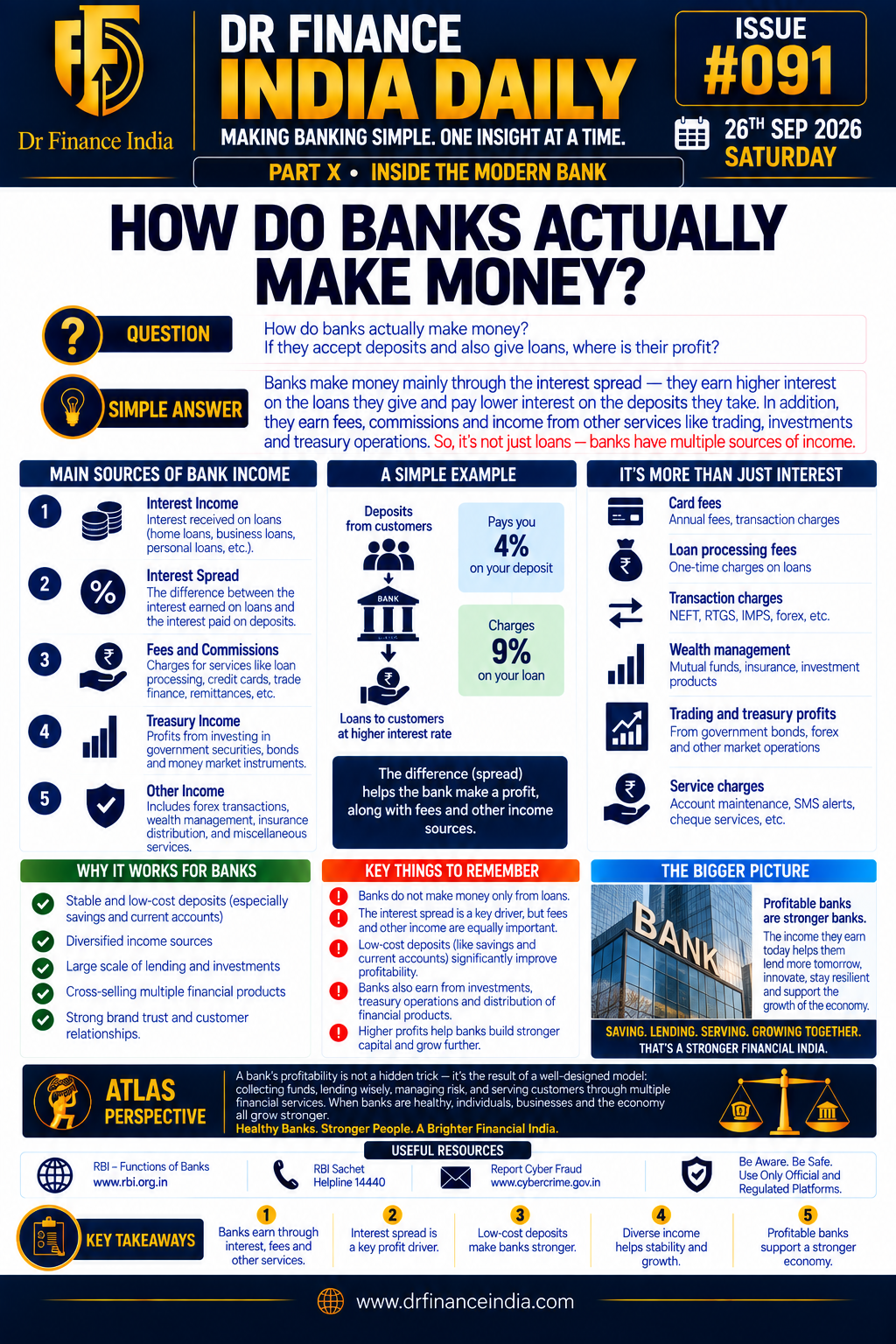
Banks earn through interest spread, fees, commissions, treasury activity and other services — a diversified income model supports a stronger banking business.
Published by Dr Finance India · Educational content — not financial advice
Official Issue Poster
The Question
How do banks actually make money?
The Simple Answer
Banks earn net interest income from the difference between what they earn on loans and what they pay on deposits, and also earn non-interest income through fees, transaction services, cards, wealth management, foreign-exchange activity and treasury operations.
Why It Matters
Understanding how banks earn helps explain why loan rates, deposit rates, fees and banking relationships are interconnected.
Detailed Explanation
Banks do much more than simply collect deposits and lend money. Their core earnings commonly begin with net interest income: the difference between interest earned on loans and other earning assets and the interest paid on deposits and borrowings.
Banks can also earn non-interest income through processing charges, transaction services, cards, distribution of financial products, foreign-exchange activity, wealth-management services and treasury operations. The exact mix differs from bank to bank.
A strong banking model therefore depends on more than loan growth. Funding cost, pricing, asset quality, operating efficiency, fee income and prudent risk management all influence profitability.
Key Takeaways
- ✓Banks earn net interest income from the spread between lending yields and deposit costs.
- ✓Non-interest income includes fees, cards, wealth management and treasury activity.
- ✓The exact income mix differs from bank to bank.
- ✓Profitability depends on funding cost, pricing, asset quality and operating efficiency.
- ✓Loan rates, deposit rates and fees are all connected through a bank's economics.
Borrower Takeaway
A bank's business model is built around managing money, risk and services together. Understanding this helps explain why loan rates, deposit rates, fees and banking relationships are interconnected.
Atlas Perspective
A bank's business model is built around managing money, risk and services together. Understanding this helps explain why loan rates, deposit rates, fees and banking relationships are interconnected.
Share This Insight
Related Issues