
DR Finance India Daily
How Banks Detect Fraud in Loan Applications
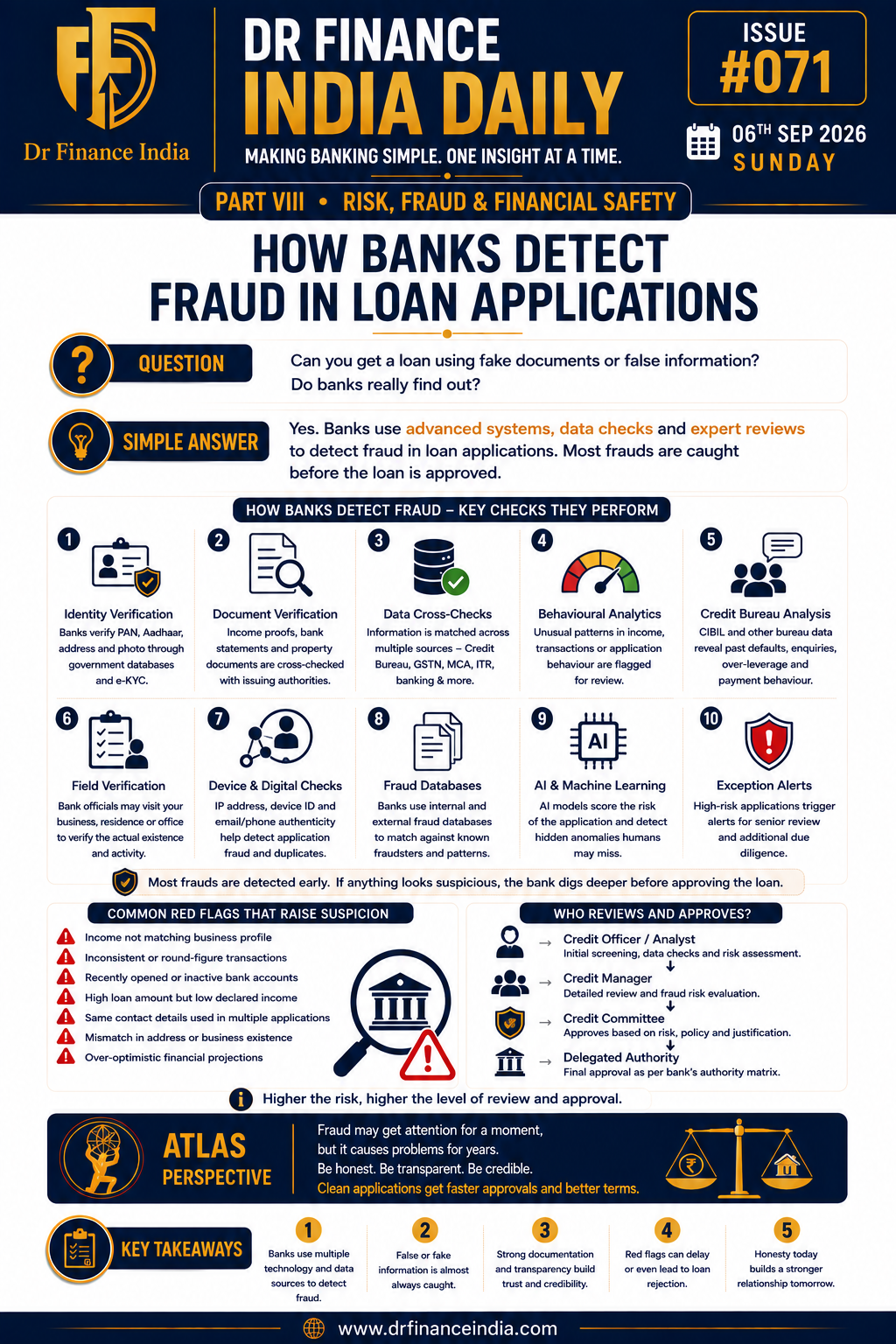
Banks do not rely only on submitted documents — they use multiple checks to verify whether information is genuine, consistent and supported by independent data.
Published by Dr Finance India · Educational content — not financial advice
Official Issue Poster
The Question
How do banks detect fraud in loan applications?
The Simple Answer
Banks use multiple checks — identity verification, document authentication, bureau data, transaction analysis and field verification — to identify inconsistencies and higher-risk patterns before making a credit decision.
Why It Matters
Understanding how banks detect fraud helps borrowers appreciate why transparency and accuracy matter. Inconsistencies can trigger additional scrutiny, delays or rejection even when the underlying application is otherwise sound.
Detailed Explanation
Banks do not rely only on the documents submitted with a loan application. They use multiple checks to verify whether the information provided is genuine, consistent and supported by independent data.
Identity and KYC information may be verified alongside income records, bank statements, credit-bureau data, tax information and other relevant sources. Lenders may also review transaction behaviour, application patterns, device or digital information, field-verification findings and known fraud indicators.
Applications that show unusual inconsistencies or higher-risk patterns can be escalated for additional scrutiny before a credit decision is made. The exact process varies by lender, product and risk policy.
Key Takeaways
- ✓Banks verify identity, income, bureau data and transaction behaviour.
- ✓Multiple independent sources are cross-checked against submitted documents.
- ✓Inconsistencies can trigger additional scrutiny or delays.
- ✓Field verification and digital information may also be reviewed.
- ✓Transparency makes a credit application easier to verify and approve.
Borrower Takeaway
Submit accurate information and genuine documents. Transparency makes a credit application easier to verify, while inconsistencies can result in additional checks, delays or rejection.
Atlas Perspective
Transparency is not just an ethical requirement — it is the most practical path through a lender's verification process. A genuine application with consistent information is far easier to approve than one that raises questions.
Share This Insight