
DR Finance India Daily
What Is a Credit Deviation — and Who Can Approve It?
A credit deviation arises when a loan proposal falls outside normal credit policy parameters but is still considered, requiring documented rationale and appropriate approval authority.
Official Issue Poster
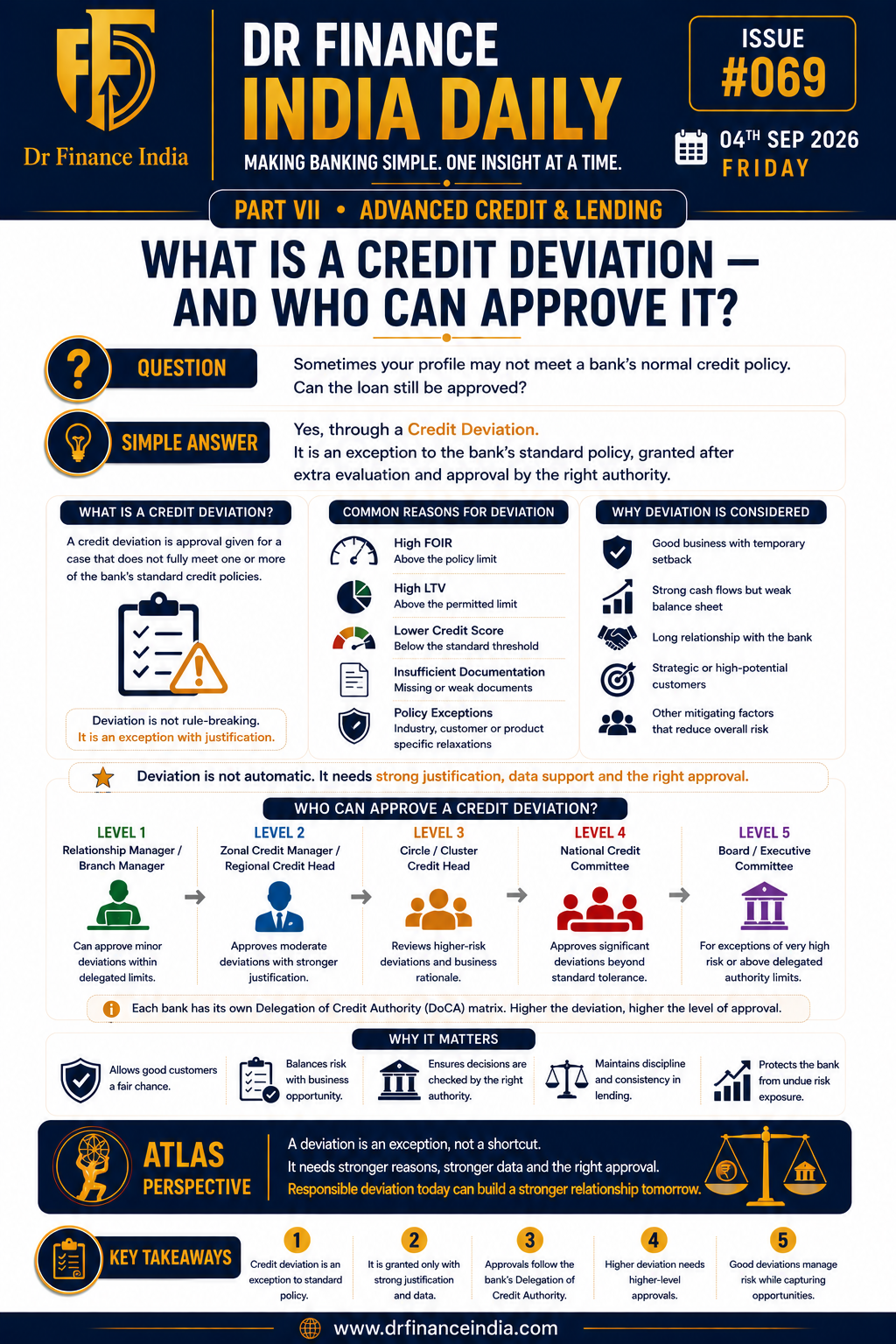
The Question
What happens when a loan proposal does not fit a lender's standard credit policy?
The Simple Answer
The lender may consider it as a credit deviation — an exception to normal policy that requires documented justification and approval from the right authority.
Why It Matters
Understanding credit deviations helps borrowers appreciate why transparency and strong mitigating factors matter. A well-presented proposal with genuine strengths can support an exception within policy.
Detailed Explanation
A credit deviation arises when a loan proposal falls outside one or more parameters of a lender's normal credit policy but is still considered for further evaluation.
Examples can include exceptions relating to financial ratios, documentation, security, borrower profile or other policy conditions. A deviation is not an automatic waiver. The lender normally needs a documented rationale, relevant mitigating factors and approval from an authority permitted under its internal delegation framework.
The approving authority and types of deviations permitted differ between lenders. More material exceptions may require escalation to higher credit authorities or committees.
Key Takeaways
- ✓A deviation is an exception to normal credit policy.
- ✓It requires documented rationale and appropriate approval.
- ✓Mitigating factors and transparency strengthen the case.
- ✓More material exceptions require higher authority approval.
- ✓Never treat a deviation as an entitlement or shortcut.
Borrower Takeaway
A deviation should never be treated as an entitlement or shortcut. A transparent explanation, supporting evidence and genuine strengths elsewhere in the proposal can help the lender evaluate an exception within its policy.
Atlas Perspective
A deviation is not a shortcut — it is an exception that must be earned. Present your case honestly, highlight genuine strengths, and let the lender's process work as it should.